
 Intelligent virtual laboratory for schools and universities
A laboratory students can actually drive.
Open a prepared experiment, change the parameters, pause at any instant and ask about exactly what you see. Every number comes from a real solver — never from a guess.

 No lecturer needed to explore
- Grounded in a tested model
- Runs in any modern browser
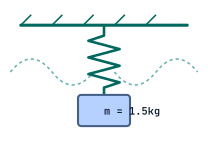
- Drive f
- 0.90 Hz
- Natural f₀
- 1.01 Hz
- Phase lag δ
- 22.9°
“Why does the mass lag the crank here?”
At this moment the drive is 0.90 Hz, just below the natural frequency of 1.01 Hz, so the steady displacement lags the driver by 22.9°. Tune closer to f₀ and the lag approaches 90°.
Answer drawn from this run's numbers · ideal oscillator model
How it works
From a question to a working experiment in seconds
Helix chooses from a catalogue of prepared experiments, so what you drive is always a checked model — not something improvised on the spot.
- 01
Say what you want to try
Type a goal like “see resonance in a driven spring”. Helix opens the matching prepared experiment, asks one clarifying question, or tells you plainly it can’t model that yet.
- 02
Drive the apparatus
Drag a slider or type an exact value. The rig and its traces move together on one clock, and values outside the model’s range are refused with a one-line reason.
- 03
Pause, point, and ask
Stop at any instant, click a named part such as the spring, and ask about that exact moment. Answers use the numbers from your run — nothing invented.
Features
Serious physics, presented simply
Clean controls on the surface, a tested model underneath, and nothing in between that makes things up.

A real solver underneath
Each experiment is a versioned pack with a forward model tested against its published limits. A language model never produces a number.

Named, selectable parts
Click the mass, spring or driving arm. Every selection is a part from the pack, so questions are bound to real apparatus, not pixels.

Honest parameter ranges
Sliders and typed fields share one published range. Step outside it and Helix explains which model assumption would break.

Guided pathways
Off resonance, near resonance, past resonance. Each step is a contrast a deterministic check verifies before you move on.

Save and resume exactly
Knobs, pause time, selected part and pathway step are restored precisely, so a lesson can continue tomorrow where it stopped.

Built for ordinary laptops
The browser asks for traces only when a parameter changes, then animates locally. It stays smooth on school machines and patchy networks.
For lecturers
Marks you can walk back to the moment they were earned
A small, self-contained class space: invite students by email, set a pathway, and see an ordered trail of what each student did.

Evidence, not prose
Points come from passed checks, predictions that match the trace, and required pauses — never from how fluent a paragraph sounds.
Every point cites an event
Click a mark to reopen the lab at that exact moment, with the part selected and the trace up to that time.
No integration project
Create a class, share a code, publish an assignment. Nothing to connect to an external LMS.
Score ledger · illustrative
Resonance Investigation
- t = 3.07 s

Off resonance check passed
lag 2.5° · gain 1.55×
- t = 14.20 s
Near resonance check passed
lag 89.6° · gain 21.1×
- t = 18.40 s
Required pause at maximum lag
spring selected
A point with no event behind it is invalid by design.
Principles
Trustworthy by construction
Students should be able to say the plot was a model, and know exactly which model. Helix is built so that is always true.
Physics first
The solver is the source of truth for every number, trace and phenomenon.
Prepared, not improvised
Apparatus is authored, checked and frozen before a student ever sees it.
Grounded answers
Explanations may only use the run record and the pack’s own vocabulary.
Fail closed
Off-catalog goals and questions about parts that aren’t there are refused.
Subjects
Physics today. One engine for every lab.
New subjects arrive as new experiment packs with the same shape, so the player you learn once works everywhere.
Physics
AvailableMechanics, oscillations and resonance
Chemistry
PlannedSame engine, new packs
Biology
PlannedSame engine, new packs
Engineering
PlannedSame engine, new packs
Open your first experiment
Sign in, pick the driven oscillator, and find resonance for yourself. It takes about eighteen minutes.